Running Java Web Applications on Heroku Cedar Stack

Update: Heroku now does support Java.

Heroku does not officially support Java applications yet (yes, it does). However, the most recently launched stack comes with support for Clojure. Well, if Heroku does run Clojure code, it is certainly running a JVM. Then why can we not deploy regular Java code on top of it?

I was playing with it today and found a way to do that. I admit, so far it is just a hack, but it is working fine. The best (?) part is that it should allow any maven-based Java Web Application to be deployed fairly easy. So, if your project can be built with maven, i.e. mvn package generates a WAR package for you, then you are ready to run on the fantastic Heroku Platform as a Service.

Wait. There is more. In these polyglot times, we all know that being able to run Java code means that we are able to run basically anything on top of the JVM. I’ve got a simple Scala (Lift) Web Application running on Heroku, for example.

There are also examples of simple spring-roo and VRaptor web applications. I had a lot of fun coding on that stuff, which finally gave me an opportunity to put my hands on Clojure. There are even two new Leiningen plugins: lein-mvn and lein-herokujetty. 🙂

VRaptor on Heroku

Let me show you what I did with an example. Here is a step-by-step to deploy a VRaptor application on Heroku Celadon Cedar:

  1. Go to Heroku and create an account if you still do not have.
  2. We are going to need some tools. First Heroku gems:
    $ gem install heroku
    $ gem install foreman
    
  3. Then Leiningen, the clojure project automation tool. On my Mac, I installed it with brew:
    $ brew update
    $ brew install leiningen
    
  4. The vraptor-scaffold gem, to help us bootstrap a new project:
    $ gem install vraptor
    

That is it for the preparation. We may now start dealing with the project.

  1. First, we need to create the project skeleton:
    $ vraptor new <project-name> -b mvn
    $ lein new <project-name>
    $ cd <project-name>
    

    The lein command is not strictly necessary, but it helps with .gitignore and other minor stuff.

  2. Now, the secret sauce. This is the ugly code that actually tries to be smart and tricks Heroku to do additional build/compilation steps:
    $ wget https://gist.github.com/raw/1129069/f7ffcda9c42a3004fa8d3c496d4f13887c11ebf4/heroku_autobuild.clj -P src
    

    Or if you do not have wget installed:

    $ curl -L https://gist.github.com/raw/1129069/f7ffcda9c42a3004fa8d3c496d4f13887c11ebf4/heroku_autobuild.clj > src/heroku_autobuild.clj
    
  3. You also need to tweak the Leiningen project definition – project.clj. The template is here. Please remember to adjust your project name. It must be the same that you are using in the pom.xml. Or you may download it directly if you prefer:
    $ curl -L https://gist.github.com/raw/1129081/5790e173307d28a8df256e0aaa5a9fe7757e922f/project.clj > project.clj
    
  4. Unfortunately, Leiningen comes bundled with an old version of the Maven/Ant integration. The embedded maven is currently at version 2.0.8, which is old. The versions of some plugins configured in the default pom.xml from vraptor-scaffold are incompatible with this old version of maven.

    The best way to solve it for now is to remove all <version> tags from items inside the <plugins> section of your pom.xml. This is specific to VRaptor and other frameworks may need different modifications. See below for spring-roo and Lift instructions.

    If even after removing versions from all plugins, you still get ClassNotFoundException: org.apache.maven.toolchain.ToolchainManager errors, try cleaning your local maven repository (the default location is $HOME/.m2/repository). The pom.xml that I used is here.

  5. Now, try the same command that Heroku uses during its slug compilation phase. It should download all dependencies and package your application in a WAR file inside the target directory.
    $ lein deps
    

    Confirm that the WAR was built into target/. It must have the same name as defined in your project.clj.

  6. Create your Heroku/Foreman Procfile containing the web process definition:
    web: lein herokujetty
    

    And test with:

    $ foreman start
    

    A Jetty server should start and listen on a random port defined by foreman. Heroku does the same.

  7. Time to push your application to Heroku. Start editing your .gitignore: add target/ and tmp/, and please remove pom.xml. Important: The pom.xml must not be ignored.
  8. You may also remove some unused files (created by leiningen):
    $ rm -rf src/<project-name>
    # do not remove src/main src/test and src/heroku_autobuild.clj!
    
  9. Create a git repository:
    $ git init
    $ git add .
    $ git commit -m "initial import"
    
  10. Push everything to Heroku and (hopefully) watch it get built there!
    $ heroku create --stack cedar
    $ git push -u heroku master
    
  11. When it ends, open another terminal on the project directory, to follow logs:
    $ heroku logs -t
    
  12. Open the URL that heroku creates and test the application. You may also spawn more instances and use everything Heroku has to offer:
    $ heroku ps:scale web=2
    $ heroku ps:scale web=4
    $ heroku ps:scale web=0
    
  13. Quick tip: you do not have SSH access directly to Dynos, but this little trick is very useful to troubleshoot issues and to see how slugs were compiled:
    $ heroku run bash
    

spring-roo on Heroku

Once you understand the process for a VRaptor application, it should be easy for others as well. Just follow the simple step-by-step here, to create a simple spring-roo maven application.

Then, before running lein deps or foreman start, you must adjust your pom.xml, to remove plugins incompatible with the older mvn that is bundled in Leiningen. Here is the pom.xml that I am using (with some of the plugins downgraded).

You can see my spring-roo application running on Heroku here.

Scala/Lift on Heroku

The same for Scala/Lift: follow the instructions to bootstrap an application with maven. One simple change to the pom.xml is required. My version is here.

You also need to turn off the AUTO_SERVER feature of H2 DB. It makes H2 automatically starts a server process, which binds on a tcp port. Heroku only allows one port bound per process/dyno, and for the web process, it must be the jetty port.

To turn it off, change the database URL inside src/main/scala/bootstrap/liftweb/Boot.scala. I changed mine to a in-memory database. The URL must be something similar to jdbc:h2:mem:<project>.db.

My Lift application is running on Heroku here.

I hope it helps. Official support for Java must be in Heroku’s plans, but even without it yet, we’ve got a lot of possibilities.
Ruby and dependency injection in a dynamic world

It’s been many years I’ve been teaching Java and advocating dependency injection. It makes me design more loosely coupled modules/classes and generally leads to more extensible code.

But, while programming in Ruby and other dynamic languages, the different mindset always intrigued me. Why the reasons that made me love dependency injection in Java and C# don’t seem to apply to dynamic languages? Why am I not using DI frameworks (or writing simple wiring code as I did many times before) in my Ruby projects?

I’ve been thinking about it for a long time and I don’t believe I’m alone.

DI frameworks are unnecessary. In more rigid environments, they have value. In agile environments like Ruby, not so much. The patterns themselves may still be applicable, but beware of falling into the trap of thinking you need a special tool for everything. Ruby is Play-Doh, remember! Let’s keep it that way.

— Jamis Buck

Even being a huge fan of DI frameworks in the Java/C# world (particularly the lightweights), I completely agree with Jamis Buck (read his post, it’s very good!). This is a recurrent subject in talks with really smart programmers I know and I’ve tried to explain my point many times. I guess it’s time to write it down.

The whole point about Dependency Injection is that it is one of the best ways to achieve Inversion of Control for object dependencies. Take the Carpenter object: his responsibility is to make and repair wooden structures.

class Carpenter {
    public void repair(WoodenStructure structure) {
        // ...
    }
    public WoodenStructure make(Specification spec) {
        // ...
    }
}

Because of his woodwork, the carpenter often needs a saw (dependency). Everytime the carpenter needs the saw, he may go after it (objects who take care of their dependencies on their own).

class Carpenter {
    public void repair(WoodenStructure structure) {
        PowerSource powerSource = findPowerSourceInsideRoom(this.myRoom);
        Saw saw = new ElectricalSaw(powerSource);

        // ok, now I can *finally* do my real job...
    }
}

The problem is that saws could be complicated to get, to assemble, or even to build. The saw itself may have some dependencies (PowerSource), which in turn may also have some dependencies… Everyone who needs a saw must know where to find it, and potencially how to assemble it. What if saw technology changes and some would rather to use hydraulic saws? Every object who needs saws must then be changed.

When some change requires you to mess with code everywhere, clearly it’s a smell.

Have you also noticed that the carpenter has spent a lot of time doing stuff which isn’t his actual job? Finding power sources and assembling saws aren’t his responsibilities. His job is to repair wooden structures! (Separation of Concerns)

One of the possible solutions is the Inversion of Control principle. Instead of going after their dependencies, objects receive them somehow. Dependency Injection is the most common way:

class Carpenter {
    private Saw saw;
    public Carpenter(Saw saw) {
        this.saw = saw;
    }
    public void repair(WoodenStructure structure) {
        // I can focus on my job!
    }
}

Now, the code is more testable. In unit tests where you don’t care about testing saws, but only about testing the carpenter, a mock of the saw can be provided (injected in) to the carpenter.

In the application code, you can also centralize and isolate code which decides what saw implementation to use. In other words, you now may be able to give the responsibility to do wiring to someone else (and only to him), so that objects can focus on their actual responsibilities (again Separation of Concerns). DI framework configuration is a good example of wiring centralized somewhere. If the saw implementation changes somehow you have just one place to modify (Factories help but don’t actually solve the problem – I’ll leave this discussion for another post).

class GuyWithResponsibilityToDoWiring {
    public Saw wireSaw() {
        PowerSource powerSource = getPowerSource();
        return new Saw(powerSource);
    }
    public PowerSource getPowerSource() { ... }
}

Ok. Plain Old Java Dependency Injection so far. But what about Ruby?

Sure you might do dependency injection in Ruby (and its dynamic friends) exactly the same way as we did in Java. But, it took some time for me to realize that there are other ways of doing Inversion of Control in Ruby. That’s why I never needed a DI framework.

First, let’s use a more realistic example: repositories that need database connections:

class Repository {
    private Connection connection;
    public Repository(Connection connection) {
        this.connection = connection;
    }
    public Something find(Integer id) {
        return this.connection.execute("SELECT ...");
    }
}

Our problem is that many places need a database connection. Then, we inject the database connection as a dependency in everywhere it is needed. This way, we avoid replicating database-connection-retrieval code in such places and we may keep the wiring code centralized somewhere.

In Ruby, there is another way to isolate and centralize common behavior which is needed in many other places. Modules!

module ConnectionProvider
  def connection
    # open a database connection and return it
  end
end

This module can now be mixed, or injected in other classes, providing them its functionality (wiring). The “module injection” process is to some degree similar to what we did with dependency injection, because when a dependency is injected, it is providing some functionality to the class too.

Together with Ruby open classes, we may be able to centralize/isolate the injection of this module (perhaps even in the same file it is defined):

# connection_provider.rb

module ConnectionProvider
  def connection
    # open a database connection and return it
  end
end

# reopening the class to mix the module in
class Repository
  include ConnectionProvider
end

The effect inside the Repository class is very similar to what we did with dependency injection before. Repositories are able to simply use database connections without worrying about how to get or to build them.

Now, the method that provides database connections exists because the ConnectionProvider module was mixed in this class. This is the same as if the dependency was injected (compare with the Java code for this Repository class):

# repository.rb

class Repository
  def find(id)
    connection.execute("SELECT ...")
  end
end

The code is also very testable. This is due to the fact that Ruby is a dynamic language and the connection method of Repository objects can be overridden anywhere. Particularly inside tests or specs, the connection method can be easily overridden to return a mock of the database connection.

I see it as a different way of doing Inversion of Control. Of course it has its pros and cons. I can tell that it’s simpler (modules are a feature of the Ruby language), but it may give you headaches if you have a multithreaded application and must use different implementations of database connections in different places/threads, i.e. to inject different implementations of the dependency, depending on where and when it’s being injected.

Opening classes and including modules inside them is a global operation and isn’t thread safe (think of many threads trying to include different versions of the module inside the class). I’m not seeing this issue out there because most of Ruby applications aren’t multithreaded and run on many processes instead; mainly because of Rails.

Regular dependency injection still might have its place in Ruby for these cases where plain modules aren’t enough.

IMO, it’s just much harder to justify. In my experience modules and metaprogramming are usually just enough.

VRaptor2 on Google App Engine

With all the recent excitement about Google supporting Java for the App Engine platform, I’m proud to say that VRaptor2 just works, out-of-the-box!

All you have to do is copy the required jars that come in the vraptor distribution, configure the VRaptorServlet (or VRaptorFilter) in web.xml and enable session support in the appengine-web.xml:

<appengine-web-app xmlns="http://appengine.google.com/ns/1.0">
	<application>...</application>
	<version>1</version>
	<sessions-enabled>true</sessions-enabled>

	<!-- ... -->
</appengine-web-app>

Being able to use my favorite Java Web MVC framework, to develop and deploy applications to Google’s cloud infrastructure, is really nice.

JettyRails 0.7, Merb 1.0 support

After the 1.0 official release, Merb is gaining more and more attention.

I’ve updated JettyRails to support Merb 1.0 applications, making it a good choice to run your rails and merb applications with JRuby, particularly in development time.

The release notes include:

* Merb 1.0 support!
* jruby-rack updated to the latest release (0.9.3)
* jetty server update to 6.1.14
* JSP and JSP Expression Language support
* some minor bugs

It is very simple to run any Merb 1.0.x and Rails 2.x applications. You just need to have JRuby properly installed, but JettyRails doesn’t work with jruby-1.1.4 (JRUBY-2959). First step is to install jetty-rails:

jruby -S gem install jetty-rails

Then, for Rails applications:

cd myrailsapp
jruby -S jetty_rails

And for Merb applications:

cd mymerbapp
jruby -S jetty_merb

Please note that you can’t use Merb with DataMapper in JRuby right now, but ActiveRecord does the job. Work is being done by Yehuda Katz (wycats) and Nick Sieger to port the native parts of DataObjects (used by DataMapper) in the do_jdbc project. Because of that, you can’t just install the merb gem. Wanted Merb modules should be installed separately:

jruby -S gem install merb-core # required
jruby -S gem install merb-more # extras

Play with JMaglev yourself

JMaglev is finally public available!

I’m releasing my experiments with JRuby and Terracotta, so you can play with JMaglev and contribute some code. The project is in Github.

I had to patch JRuby to make RubyObjects a little less dependent from the JRuby Runtime. It isn’t perfect yet, but is working. The patch against the current jruby trunk (rev. 8091) and the patched jruby-complete are included in the project.

The code in Github is just a TIM (Terracotta Integration Module) with a sample maven project and the JMaglev use-case included. Unfortunately, I haven’t any time yet to upload the TIM to Terracotta Forge. BTW, does anyone know how to do this?

For those who want to reproduce my JMaglev demo, here is a step-by-step. You must have GIT, Maven 2 and the JDK properly installed. It only works on Linux and OS X. Is anyone wanting to contribute support for Windows users?

  1. git clone git://github.com/fabiokung/clustered-jruby.git
  2. long time waiting, because terracotta-2.7.1 (vanilla) and jruby-complete (patched) are bundled.
  3. cd clustered-jruby
  4. mvn install (although mvn package is enough)
  5. cd jmaglev
  6. start the terracotta server:
    lib/terracotta-2.7.1/bin/start-tc-server.sh
  7. open another two terminals
  8. run the simplified jirb inside them:
  9. cd clustered-jruby/jmaglev
    ./bin/jmaglev jmaglev.rb

  10. Follow the demo. You will be able to share global variables among all jmaglevs:
    require 'hat'
    $hat
    require 'rabbit'
    $hat.put(Rabbit.new)
    
  11. in the other terminal, try to see the magic hat contents:
    $hat
    

I haven’t tested it with rails applications, but right now, it isn’t able to run IRB. I never thought that running IRB could be so hard. 🙂

More drawbacks and limitations are being discussed in the JRuby Users Mailing List.

I hope to see many contributions. Happy hacking!

EJB 4: the Future

Reading an article from Reza Rahman in TSS about what is new in EJB 3.1, I could predict the future. Here is a code snippet from the article:

EJBContainer container = EJBContainerFactory.createEJBContainer();
Context context = container.getContext();
PlaceBid placeBid = (PlaceBid) context.lookup("java:global/action-bazaar/PlaceBid");
placeBid.addBid(new Bid("rrahman", 10059, 200.50));
container.close();

Yes, PicoContainer will be standardized as EJB 4.0!

How long is going to take to people learn that less is more?

This is obviously a joke. It isn’t really true.

JRuby, sharing objects across multiple runtimes. JMagLev?

MagLev was a show from the last RailsConf (2008). Presentation and demos of the product are really impressive.

Recently, Brian Takita asked in the JRuby mailing list:

JRuby + TerraCotta == Maglev?

What an idea! In the last few days I’ve tried to make something useful and I’m happy to have something to show.

JRuby + Nailgun and JRuby + Terracotta

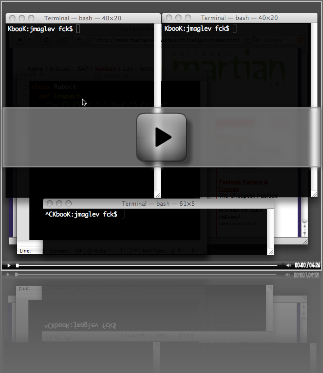
Screencast: Reproducing Avi Bryant's Demo with JRuby + Nailgun and JRuby + Terracotta. (5 min)

The first demo runs with Nailgun. The basic idea is to share a single Java VM across all clients, so they can share some objects. The second is much more complete, as its clients have their own Java VM. There are many true interpreters running, and they are sharing objects through Terracotta. Terracotta is responsible for sharing memory in Java VM clusters and, despite of its slow startup, has much more to offer. The shared objects (hats and rabbits) could be automatically persisted by Terracotta, as MagLev also does.

I’ve patched JRuby and configured Terracotta to make demos run. I’ll upload the patches and configuration somewhere, ASAP.

Working on JRuby to make it run multiple runtimes (VMs) at the same time is being really fun!

Revising my opinion about Spring Framework

In past, at comm.world (Germany), I worked with projects based on Spring. At that time, I built my opinion about the framework: useless. It had nothing you couldn’t do without it. Everything that came with Spring could be done in simpler ways: PicoContainer or plain constructor injection for IoC/DI, plain decorators, dynamic proxies or Servlet Filters instead of AOP for the same results, WebWork simpler than Spring MVC, …

Some time has passed and, influenced by some friends in our endless discussions about Spring, I’ve decided to give it another try and I’ve started to refactor the VRaptor Web Framework, changing it to be fully Spring-based.

After this experience, I must admit: I was a bit wrong. I am going to explain it better, but I think the best part of Spring is that it already comes with many things done, ready to be used; out of the box. Furthermore, Spring 2.5 is much, much better.

Now, I have the sense that Spring brings some complexity, compared to lightweight alternatives; but not that much. This is the cost for the benefits the framework introduces. It is extremely flexible, supporting many different programming styles and idioms. I would be able to completely rewrite VRaptor to use Spring building blocks. Most of the current frameworks could be changed to be Spring-based, with little influence in their current APIs and programming styles!

People has already (re)implemented Google Guice on top of Spring. The EJB3 programming model (@EJB, @PersistenceContext, @Stateless, @Stateful, @Resource, …) can be easily replicated on Spring applications (old – 2005 – article that may be done better nowadays). One could even provide an EJB3 implementation on top of Spring, JBoss Seam could be rewritten on top of Spring and even PicoContainer could be Spring-based.

My current opinion is that Spring is a truly framework, in its original sense, because it acts as a solid base for applications to be built on top of it, without imposing any programming model, style or idiom. You aren’t required to use XML, Spring classes and even Spring annotations. The little bureaucracy comes with a bunch of ready functionality to be used, and with the great flexibility the framework has to be extended.

Today I can say I would consider using Spring Framework for new projects. I even consider it to be a good candidate to become one or more JSRs. It is a great base for applications and other frameworks to be built on top of it. Rod Johnson is a member of Java EE 6 Expert Group, which could point things to something in this direction.

jetty-rails 0.4 is also jetty-merb

I’ve just released a new version of the jetty-rails gem. Now, you can also run Merb applications inside JRuby and Jetty!

jruby -S gem install jetty-rails
cd mymerbapp
jruby -S jetty_merb

Unfortunately, it’s blocking my console (ctrl + c doesn’t terminate it). Has anyone suggestions on this?

I’ve also updated the basic documentation, as you can see here.

The Merb support was actually done in JRuby Rack. It was quite simple to support it. Many thanks to Nick Sieger, Dudley Flanders e cia!

jetty-rails gem – Simple JRuby On Rails Development with Servlet Containers

This is the first time I’m writing about it, but jetty-rails is already 0.3!

Most people doing JRuby on Rails development are using JMongrels1 for development and some real Java Application Server in production.

The common flow is:

$ jruby script/server 
=> Booting Mongrel (use 'script/server webrick' to force WEBrick)
=> Rails application starting on http://0.0.0.0:3000
=> Call with -d to detach
=> Ctrl-C to shutdown server
** Starting Mongrel listening at 0.0.0.0:3000
** Starting Rails with development environment...

code, code, test, code, code, test, … (shouldn’t it be red-green-refactor?)

$ jruby -S warble
$ cp myapp.war $TOMCAT_HOME/webapps
$ $TOMCAT_HOME/bin/startup.sh

Sure you can automate those things with ant, rake, sake or anything else. Some people are still using the goldspike-plugin, but be warned: I suspect it won’t get much more attention.

The great Warbler from Nick Sieger is becoming the de facto standard for JRuby on Rails packaging. The Warbler’s recent move from goldspike to JRuby-Rack adapter reveals two interesting points:

  1. Goldspike is likely going to be deprecated (or merged with jruby-rack adapter?).
  2. Warbler will soon package any rack compatible application to be runned inside Java Containers. Such applications include Merb, Sinatra, Vintage, Camping ones, and growing

Although Warbler works really well, it introduces complexity in the development cycle. You can no more save code and immediately test it in your browser:

  1. change code;
  2. warble it;
  3. deploy war file;
  4. restart server; (takes long time)
  5. open browser;
  6. change code;

It breaks one of the most important rails development characteristics: instant feedback. During development, it’s very important to see changes without have to wait for server/context restarting.

JMongrel and Glassfish Gem are good candidates for JRuby on Rails development with instant feedback, but you can’t use Java (Servlet specification) specific features, such as web.xml; they aren’t complete Servlet Containers. Some things have an alternative in pure-rails as Servlet Filters and Servlet Listeners, but many haven’t. Servlet Context might be a good way to share things between rails runtimes. I know railers should “share nothing”, but -hey- sometimes it’s so good to share!

You can take the Servlet Application Context as your in-memory cache store (fragment and page caching), eliminating the need for filesystem or database overhead and even memcached, in many cases.

I had also a specific reason to share the same HttpSession between Rails and “pure Java” applications. Single sign-on wasn’t an option, so I needed to run both applications in the same context. I’m going to tell more about it soon.

Anyone can fall in cases, like mine, when you just can’t use jmongrel or glassfish_rails. Now, we fortunately have jetty-rails to rescue!

It’s a (one more) gem to run rails applications, based on the nice JRuby-Rack adapter, which I recommend you to take a look. Jetty is a very powerful Servlet Container, known for being pioneer at being embedded and at using NIO Connectors.

The gem creates a Jetty Server with two Handlers. The first is for static content and the last to serve dynamic requests using JRuby-Rack. These handlers are applied in order and request processing stops when one responds. That way, no rails code is runned to serve static content, improving response times. Take a look at the rdocs for more details.

Jetty is also very quick to start. I’ve measured (in a complete inaccurate way) some start times just for ugly2 comparison:

$ jruby -v
ruby 1.8.6 (2008-03-28 rev 6360) [i386-jruby1.1]
$ time jruby script/server
=> Booting Mongrel (use 'script/server webrick' to force WEBrick)
=> Rails application starting on http://0.0.0.0:3000
...
** INT signal received.
Exiting

real	0m13.947s
user	0m11.327s
sys	0m0.892s

$ ruby -v
ruby 1.8.6 (2007-09-24 patchlevel 111) [universal-darwin9.0]
$ time ./script/server 
=> Booting Mongrel (use 'script/server webrick' to force WEBrick)
=> Rails application starting on http://0.0.0.0:3000
...
** INT signal received.
Exiting

real	0m6.273s
user	0m1.893s
sys	0m0.611s

With the same JRuby 1.1 (and without Charles recent speedup patch for jruby startup):

$ time jruby -S jetty_rails
2008-05-04 10:50:00.846::INFO:  Logging to STDERR via org.mortbay.log.StdErrLog
2008-05-04 10:50:01.013::INFO:  jetty-6.1.9
...
2008-05-04 10:50:02.987::INFO:  Started SelectChannelConnector@0.0.0.0:8080

real	0m7.035s
user	0m4.387s
sys	0m0.296s

As you can see, jetty_rails is very close to mongrel running in MRI, but please, don’t take those numbers so seriously.

Jetty Rails should be ready to run any rails application (tell me otherwise!) with no dependencies on extra jars. All gems used by the application must be installed in your JRuby. I’ve made some simple benchmarks with JMeter and only one thread, firing 500 consecutive requests to a simple rails blog application. All requests pointed to ‘/posts’ controller, and there was only one Post is the MySQL database.

The machine used to run all tests is a Intel Core2 Duo E4500 @ 2.20GHz, 2.0GB RAM, running Ubuntu 7.10, Ruby (MRI) 1.8.6 and JRuby 1.1.1. MRI tests were done using plain ruby activerecord-mysql-adapter and JRuby tests were done using activerecord-jdbcmysql-adapter.

Mongrel: 30.7 req/s
JMongrel: 19.1 req/s

Glassfish Gem: 17.5 req/s
dropping JVM warm time: 23.8 req/s

Jetty Rails: 18.2 req/s
dropping JVM warm time: 26.6 req/s

This is obviously a simple measure, just to feel how jetty-rails is going. But I’m very happy with the results. If we ignore the time that JVM takes to warm and JIT compile things, jetty-rails comes close to Mongrel! Impressive. I knew Jetty was always very fast, but I really didn’t expect those results.

There is much more to do. Things from the roadmap I wanted to see working soon include:

  • read warble.rb configuration files and register extra jars and public folders defined there;
  • use any custom web.xml defined in config/web.xml (or config/web.erb.xml), following Wabler conventions.
  • jetty_merb
  • jetty_camping

The source code lives in GitHub. Feel free to fork, contribute, send patches and suggestions!


  1. Can we stop calling everything that comes from Java with that damn J-at-start or with –let termination? 😉
  2. I’ve stopped the processes (ctrl+c) as soon as I saw they were ready to respond to requests.